Objects of Desire
Eight hundred trees and a pool of well water: Milan at home
The Bosco Verticale, Porta Nuova’s library of trees and Portaluppi’s Villa Necchi Campiglio.

Photo Credit
Image courtesy of © Daniel Case · CC BY-SA 3.0 via Wikimedia CommonsMilan has always lived behind closed doors, in courtyards the street never sees. Its two most famous homes of the last century turned that habit inside out: a 1930s villa with a private pool in the middle of the city, and a pair of towers that wear their gardens on the outside. This is how the city learned to show off at home, and where you can look without an invitation. No prices, only buildings.
A forest on the balconies
The Bosco Verticale, by Stefano Boeri Architetti, was designed and built between 2007 and 2014: two residential towers of 110 and 76 metres, planted with 800 trees, 4,500 shrubs and 20,000 plants. The architects’ own figures are a reminder that someone has to prune all of it, at height, and that window-cleaning here involves a forester.
The towers won the International Highrise Award in 2014 and a CTBUH award in 2015. Their real achievement is visual: they turned a residential block into the image people now carry home of modern Milan, a city that until recently preferred its greenery behind a portone.
Why plant a tower at all? The answer the buildings give is that Milan had run out of ground but not of ambition. A city that grew in rings around the Duomo, its gardens tucked inside courtyards, chose to stack its greenery instead, and in doing so made the private balcony part of the public view. Nobody passing underneath has to ask whose garden it is; everybody gets to look.
A library of trees
The towers stand in Porta Nuova, the district developed by COIMA around Piazza Gae Aulenti. Its back garden is the Biblioteca degli Alberi, the BAM, inaugurated on 27 October 2018 across a 10-hectare span and designed by Inside Outside | Petra Blaisse. In 2015, before the park was planted, the site briefly grew Agnes Denes’s five-hectare Wheatfield.
It is a park named as a library, with the towers as its most expensive bookends. On a winter morning it is the best place to see the Bosco Verticale without craning your neck.
Porta Nuova is the clearest sign of how much Milan has changed in a generation: offices, homes and a park gathered around Piazza Gae Aulenti. COIMA calls it the most vibrant quarter of Milan, which is the kind of thing a developer would say, and here it is not wrong.
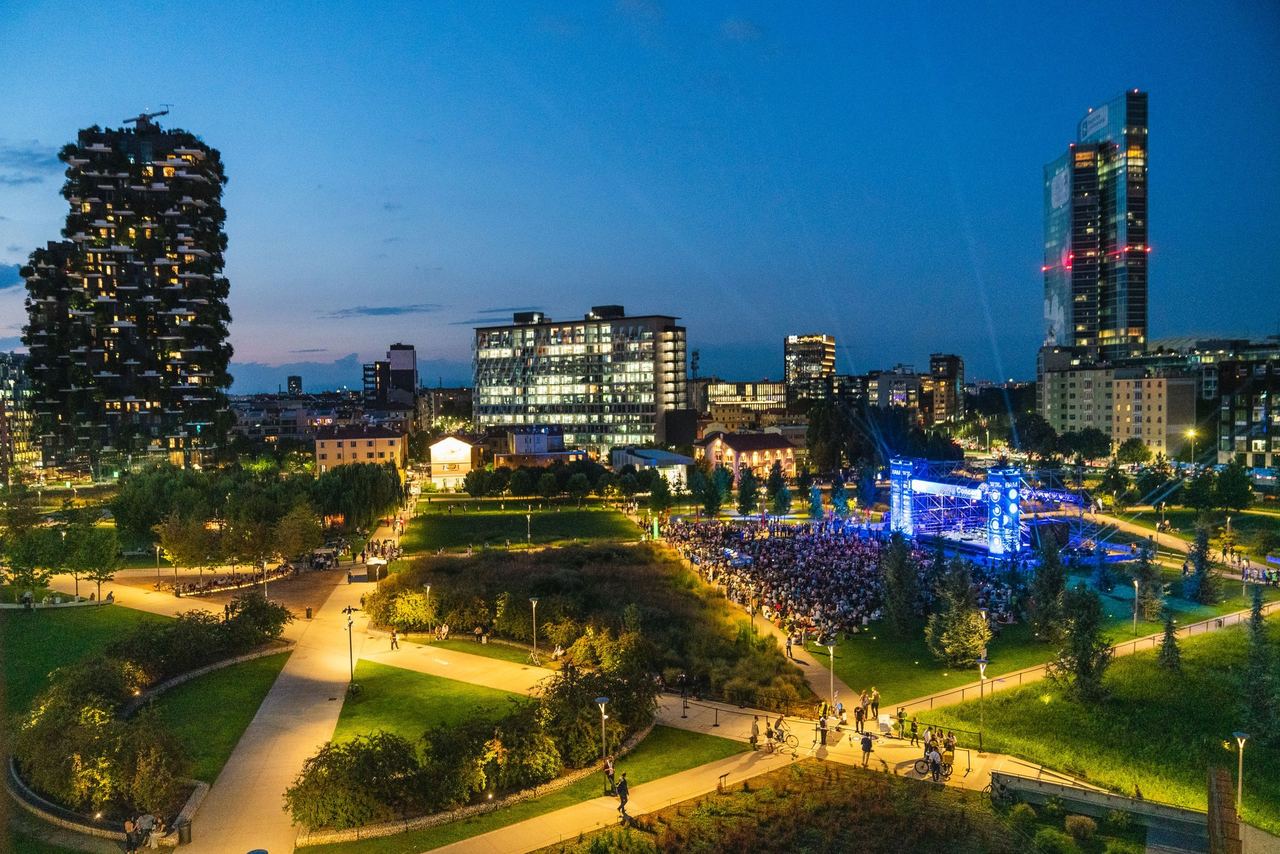
Photo Credit
Image courtesy of © Biblioteca degli Alberi (BAM)The villa with the pool
Near Porta Venezia, behind a garden wall, stands the other side of the story. Villa Necchi Campiglio was designed by Piero Portaluppi and built between 1932 and 1935 for the Necchi Campiglio family, with walnut panelling, marble and every modern comfort of its day.
The architects’ own figures are a reminder that someone has to prune all of it, at height, and that window-cleaning here involves a forester.
Its garden held a private swimming pool, which FAI, the Italian National Trust, calls an entirely original amenity for a private house in the city. It holds about 200 cubic metres and is filled with well water. Gigina and Nedda Necchi Campiglio left the villa to FAI in 2001, and it has been open to visitors since.
Inside, the walnut-panelled staircase hall shows what money and modern taste looked like in Milan between the wars. It is a house built to be lived in, then to be looked at, and FAI has kept both instincts intact. Film-makers noticed. FAI records that Io sono l’amore, with Tilda Swinton, was shot at the villa during its August closure. The villa played a grand Milanese family home, a role it could perform without a costume.
How to look
Our advice: see the Bosco Verticale from the BAM, early, when the light catches the balconies, then cross town to Villa Necchi Campiglio, checking FAI’s own page for opening days and tickets before you go. The towers, being private homes, are best admired from the lawn.
Why it's on our list
- A forest on the balconies
- A library of trees
- The villa with the pool
- How to look
Location
The map comes from Google Maps, which sets its own cookies once it loads.
More in depth
 Objects of DesireThirty millilitres each: Milan and the Negroni familyCampari’s seltz on tap, the Americano and Negroni as the IBA writes them, and Bar Basso’s Sbagliato.
 Objects of DesireLess parked than crouched: the electric Jaguar and the new supercarsJaguar’s Type 00 and Type 01, Ferrari’s first electric car and the record-breakers around them.
 Objects of DesireBox owners, a fire and a borrowed home: how Milan learned to listenLa Scala, its stand-in at the Arcimboldi, the Conservatorio and a jazz club on Via Borsieri.